General Discussion
Related: Editorials & Other Articles, Issue Forums, Alliance Forums, Region Forums
America's Founding Feminists: Rewriting America's Origin Story
(lengthy, important read. . .many links in the link below)
… There is no nation without women at its core, ready to advance beyond the strictures and limits of gender and its attending intersections, even if they had to redefine their roles and strive beyond societal expectations
America’s Founding Feminists: Rewriting America’s Origin Story
PUBLISHED 3/2/2026 by Janell Hobson
On the eve of America’s 250th anniversary, Ms. reclaims the revolution by centering the women and gender-nonconforming people whose words, labor and resistance built—and keep rebuilding—democracy.
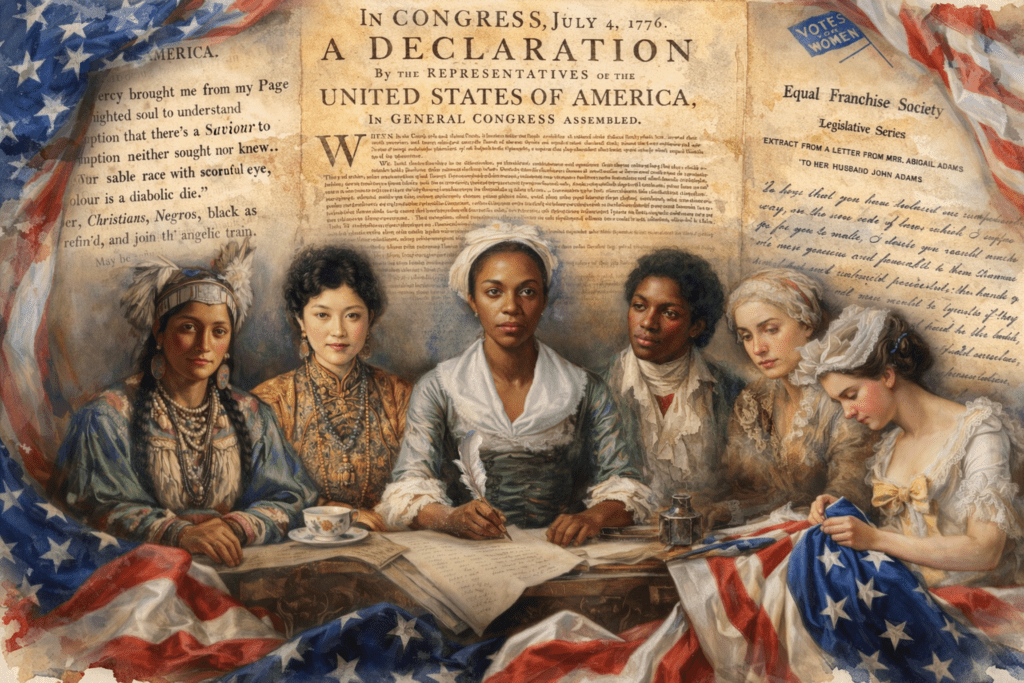
Nettrice Gaskins, Founding Feminists. (2026)
Two hundred and fifty years ago, a new nation came into being. Amid the hard-fought war for independence against the British Crown, certain leading men residing in its 13 colonies came together to sign off on a document proclaiming, “All men are created equal.” The document would be called the Declaration of Independence—authored by Thomas Jefferson and signed by 56 men now recognized as the nation’s founding fathers, immortalized in John Trumbull’s painting that hangs in the rotunda of the U.S. Capitol. They had exchanged ideas about liberty, justice, at the height of this Age of Reason; they even thought to add a statement to abolish slavery. However, they eventually decided against it, given the lucrative profits that came from the chattel institution as slave-holding individuals. And the comfort of their domestic abodes, which fell under the purview of their wives and servants, rarely induced a sense of reciprocity and full equality for the ones enabling their material surroundings.
One of the signees—John Adams (who would later serve as the nation’s vice president before succeeding George Washington, the first president of the United States)—had received admonition from his wife Abigail Adams to “remember the ladies” in their declarations for freedom and equality; however, one woman at least ensured that her name would be included on the document: Mary Katherine Goddard from Baltimore, the first woman postmaster in the colonies, printed the official documents and added her name at the bottom in typeset. Interestingly, Goddard is rarely remembered (if at all) as founding mother in her own right—in contrast to, say, Betsy Ross, whose more feminine, domestic role in sewing the first flag of the new nation secured her position in national memory. However, Goddard’s bold addition of her name to the Declaration of Independence is a prime example of how women throughout history persist and insist on their inclusion. In families. In communities. Even in nation building. Sometimes she held a pen to write her inclusion into existence, even if she remained anonymous or hid under a man’s name (a gender transition of sorts).
When she did use her own name—“written by herself”—as the enslaved poet Phillis Wheatley did, some dared to question her skill and prowess to call herself, let alone nations and worlds, into being. Despite the restrictions of slavery, Wheatley found freedom first through the pen before her eventual manumission. And when the enslaved woman could not write—indeed, deprived of this literacy by law, so potent was the knowledge it could produce—she still left a record of her existence. In the Pulitzer-Prize-winning novel Beloved by wordsmith master and Nobel laureate Toni Morrison, the former slave Sethe lamented, “I made the ink”—those indigo marks set to paper that made legible the means of her raced and gendered oppression.
Reaching through history to rescue the obscure women discounted as political subjects, Morrison did with fiction what other feminist historians like Gerda Lerner, Deborah Gray White, Paula Gunn Allen, Darlene Clark Hine, Paula J. Giddings, Kate Clifford Larson, Catherine Clinton, Annette Gordon-Reed, Stephanie M. H. Camp, Martha S. Jones, Keisha N. Blain and Edda Fields-Black, among others, had done with facts and evidence. They told the simple truth that there is no nation without women at its core, ready to advance beyond the strictures and limits of gender and its attending intersections, even if they had to redefine their roles and strive beyond societal expectations.
. . . . .
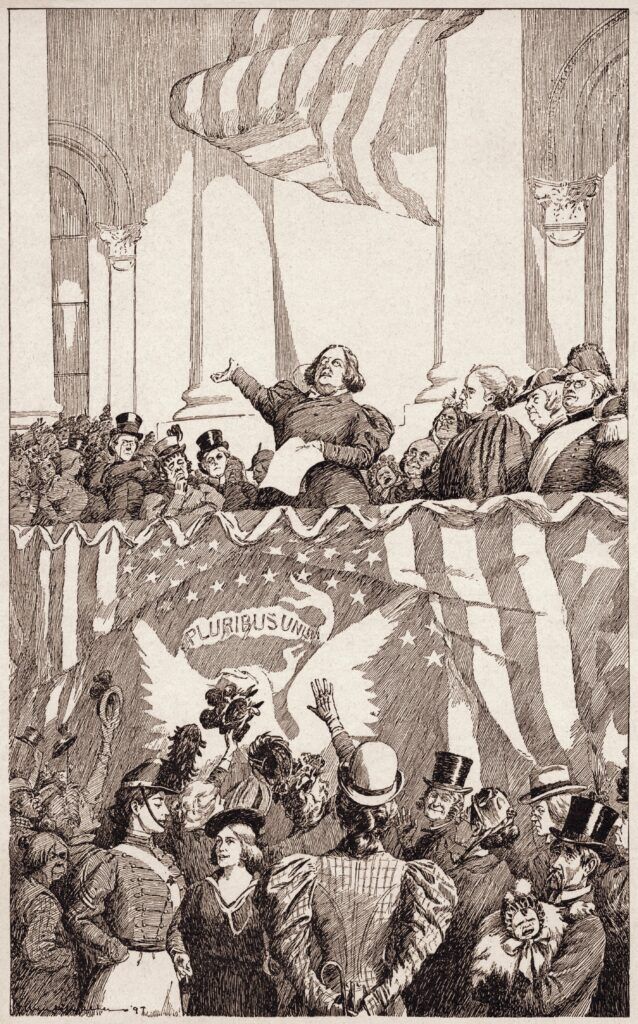
A political cartoon, “An Inauguration of the Future,” shows the effects of the women’s suffrage movement, which include a female president, female soldiers and military commanders, and a man carrying a crying baby, 1897. (Stock Montage / Getty Images)
As dated as this vision seems, such fears recirculated when the nation came close to electing a woman for president of the United States—first with Hilary Rodham Clinton who won the popular vote back in 2016, then with Kamala Harris who won 75 million votes in 2024 but came up short, both losing to a man who ran on openly sexist and racist campaigns. These fears, therefore, hardly seem outdated, as we are currently where we are because the nation failed to imagine and trust women’s leadership. We certainly have made ardent strides in the past 250 years, but where we go from here is anyone’s guess. Let us hope that we remember and recall the founding feminists who left us a guide as we plan our next moves for this ongoing and unfolding democracy.
https://msmagazine.com/2026/03/02/founding-feminists-introduction-america-250/