General Discussion
Related: Editorials & Other Articles, Issue Forums, Alliance Forums, Region Forums
Educating Women: A History of Access, Exclusion and Backlash
(lengthy, depressing, enraging, informative)
Educating Women: A History of Access, Exclusion and Backlash
PUBLISHED 4/13/2026 by Nimisha Barton
As women fought to claim higher education—from the early republic to today—race and gender determined who was allowed in, and each gain sparked a backlash aimed at restoring the status quo.
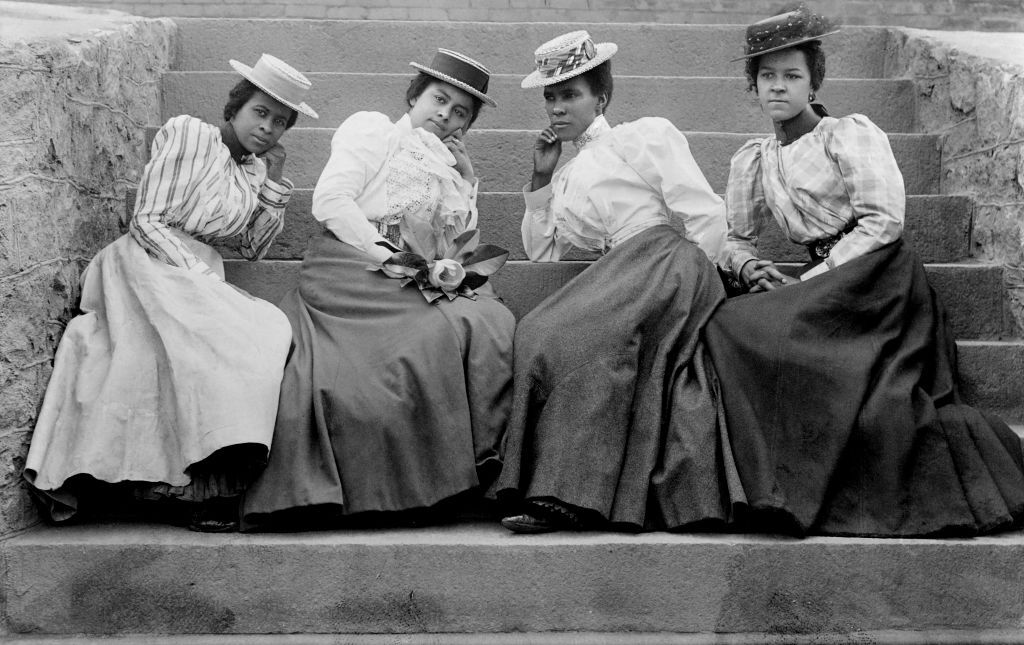
Four African American women sit together on the steps of Atlanta University in 1900, their poised expressions and fashionable dress reflecting both the dignity and determination of a generation shaping Black intellectual and cultural life at the turn of the 20th century. (Thomas E. Askew, W.E.B. Du Bois collection / Universal History Archive via Getty Images)
This essay is part of the FEMINIST 250: Founding Feminists series, marking the 250th anniversary of America by reclaiming the revolution through the women and gender-expansive people whose ideas, labor and resistance shaped U.S. democracy. Taking the form of essays, audio, poetry and original art, historians and scholars revisit the nation’s origins to center those written out of the founding documents and reimagine what a truly inclusive democracy requires.
The war against “radical gender ideology” has been staggering.
The ascent of President Trump brought calls for the elimination of women’s and LGBTQ centers, rollbacks on Title IX protections, the exclusion of trans women from college sports and the purging of gender and sexuality studies from college curricula throughout U.S. institutions and higher education. These actions signal a massive backlash against the decades-long fight for gender equality and are inseparable from the administration’s wider assault on Civil Rights-era protections for people of color. However, this moment is nothing new. It echoes an earlier race- and gender-based backlash in U.S. history over a century ago, when white middle-class American women began to attend colleges in large numbers. Against the backdrop of Black emancipation, the mass migration of racial “undesirables” and the immense success of the feminist movement, white women’s enrollment was seen as a threat, not just to white patriarchy but to the very future of the white race.
Today’s backlash is the most recent attempt to restore the status quo—to distinguish between who is and is not entitled to higher education on the basis of race and gender and to safeguard the future of a white nation. From its earliest days, Americans looked to education to stabilize the fledgling republic. In his 1778 “Bill for the More General Diffusion of Knowledge,” Thomas Jefferson made this connection explicit, writing, “the most effectual means of preventing [tyranny] would be, to illuminate … the minds of the people at large.”Revolutionary Benjamin Rush took it a step further, arguing in 1786 that women, too, “should be instructed in the principles of liberty and government, and the obligations of patriotism should be inculcated upon them.” In this manner, Rush articulated the 18th-century doctrine of republican motherhood, according to which American women were responsible for inculcating democratic values in their children and thus preparing future generations of citizens.
. . . .
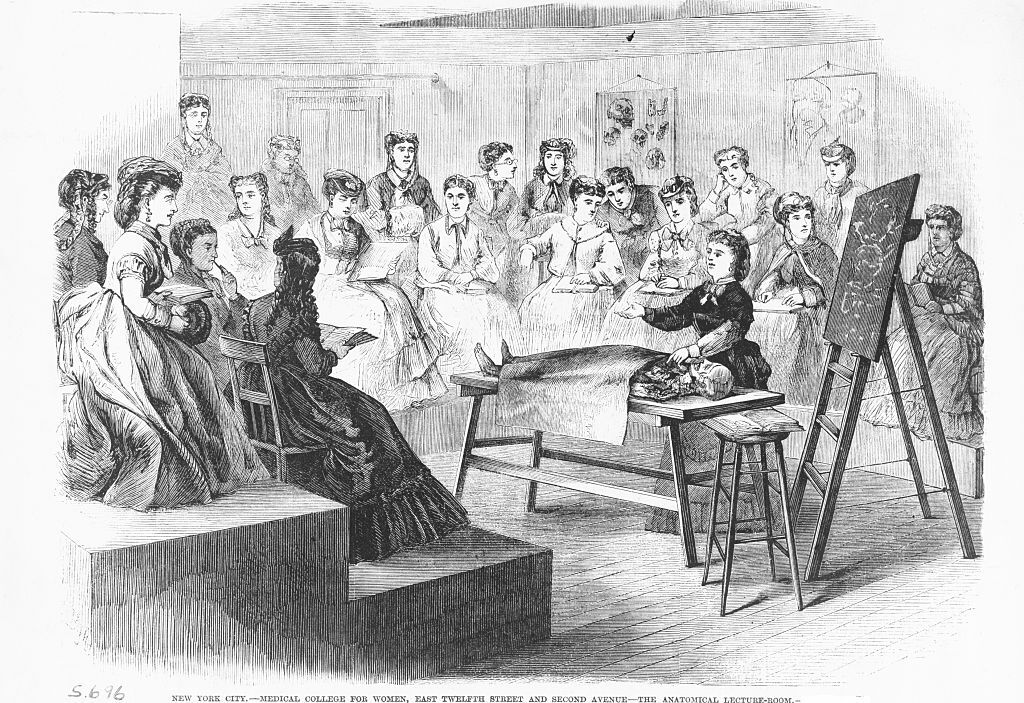
Students gather in the anatomical lecture room at the Medical College for Women in New York City, where women claimed space in professional education despite widespread resistance. (Bettmann Archives / Getty Images)
. . . .
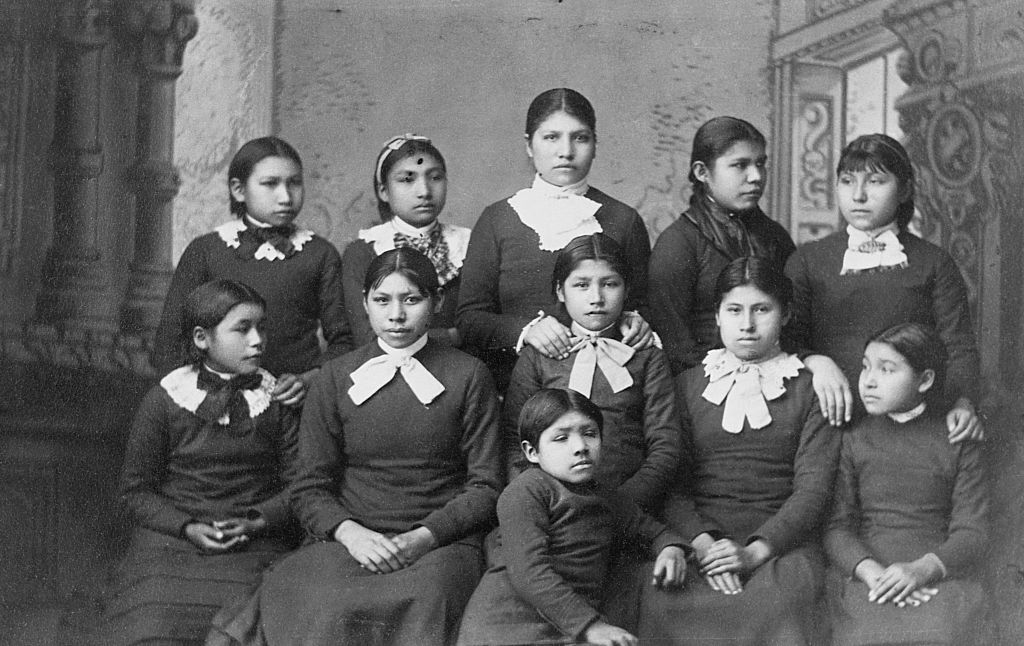
In response, Native groups were less interested in attending predominantly white institutions than beating back federal control over all facets of Native life, including education.
Native American girls from the Omaha tribe at Carlisle School in Pennsylvania. (Corbis via Getty Images)
. . . .
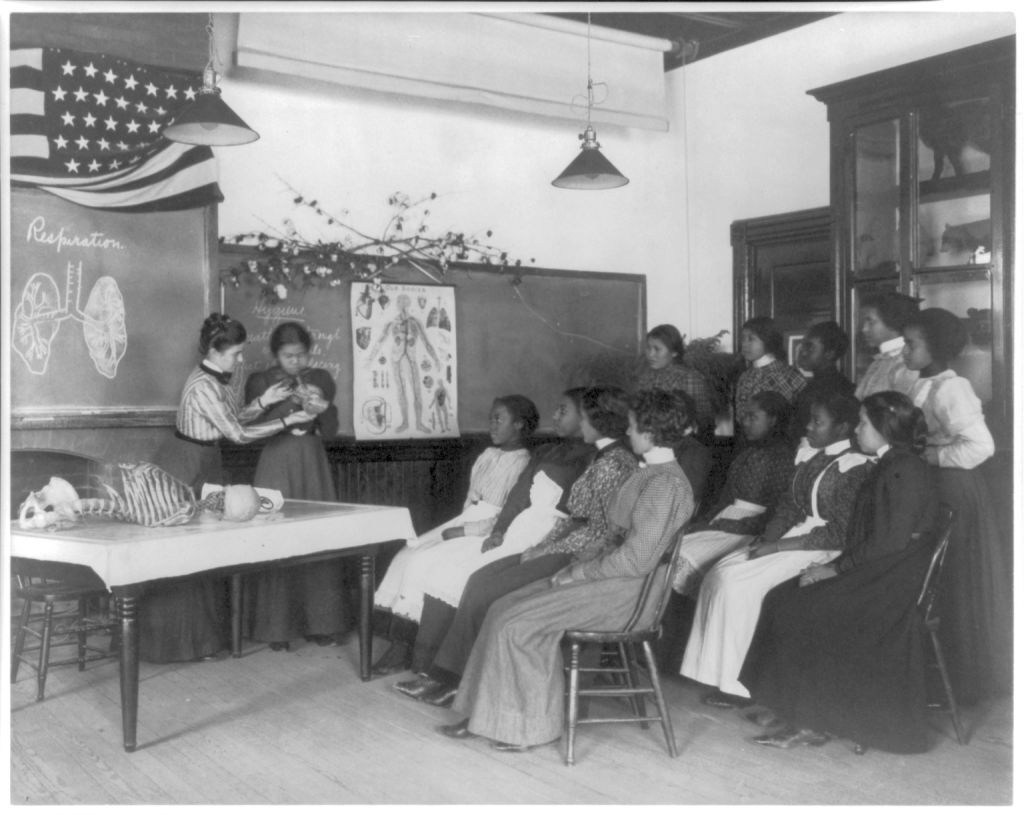
American Indian and African American students at Hampton Institute, in Hampton, Va., circa 1900. They women study the human respiratory system. Artist Frances Benjamin Johnston. (Heritage Art/Heritage Images via Getty Images)
. . . . .
Whereas an educated white woman in the eighteenth century was considered well-suited to raise future citizens, by the late nineteenth century, she was considered a threat to the future of the white race. Fears over the fate of white America pushed educators and other officials to exclude large numbers of women out of higher education and to denounce “co-education.” Then as now, racism and misogyny mutually constituted and reinforced one another in ways that limited educational opportunity for all. Not until the Civil Rights era would women advance forward in the fight for college access, when the Black Campus Movement forced white supremacy, systemic racism and other varieties of oppression onto the institutional agenda.
Group portrait of Radcliffe College Class of 1896, Harvard University. (Geography Photos / Universal Images Group via Getty Images)
In the post-Civil Rights era, gender-based exclusion in higher education appeared to be a thing of the past. Since the 1980s, more women than men attend college, though women of color attend college at lower rates than white women. They are also less likely to graduate within four years—a stark reminder of how race must be accounted for in these gendered experiences. Nonetheless, in the first quarter of the twenty-first century, women now account for over half of the nation’s college-educated labor force, making significant inroads into the highest-paying male-dominated occupations, including medicine and law. Though the gender pay gap remains, it’s narrowing in part thanks to women’s educational attainment and the struggle for gender equality that made college-going possible. In the late 1800s, a resurgence of virulent xenophobia, nativism and anti-Blackness revealed how the educational fates of all women were hopelessly intertwined. As the Trump administration works doggedly to reverse the gains of the past few decades, we would do well to remember that lesson. We must also consider the ways that white patriarchal backlash on college campuses erodes at the very foundations of our democracy, which, as our early founders first argued, requires a liberal education for all.
Explore the entire FEMINIST 250: Founding Feminists essay collection:
The main Founding Feminists page contains original art and a historical timeline and invites readers to submit original poetry.
America’s Founding Feminists: Rewriting America’s Origin Story, by Janell Hobson, professor of women’s, gender and sexuality studies at the University at Albany.
Haudenosaunee Governance: The Matrilineal Democracy That Shaped America, by Michelle Schenandoah, founder of Rematriation, a Haudenosaunee women-led nonprofit organization.
‘This Is Our Country Too!’: The Enduring Legacy of Spanish-Speaking Women in Early America, by Allyson M. Poska, professor of history emerita at the University of Mary Washington, translated by Antonia Delgado-Poust, associate professor of Spanish at the University of Mary Washington. Lea este artículo en español aquí.
Claiming the Revolution: Gender, Sexuality and the Radical Promise of 1776, by Charles Upchurch, professor of British history at Florida State University.
Reclaiming Phillis Wheatley (Peters): Imagination as a Feminist Founding Project, by Dana Elle Murphy, assistant professor of Black studies and English at Caltech.
The Radical Potential of Traditional Femininity, by Jacqueline Beatty, associate professor of history at York College of Pennsylvania.
Queer Possibilities in Revolutionary America, Jen Manion, Winkley professor of history at Amherst College.
She Wanted to Be Free: Black Women’s Revolutionary Resistance, Dr. Vanessa M. Holden, associate professor of history, director of African American and Africana studies at the University of Kentucky, and director of the Central Kentucky Slavery Initiative.
Sally Hemings and the Making of Democracy, Jessina Emmert, doctoral candidate in the Department of Women’s, Gender and Sexuality Studies at the University of Kansas.
The Abolitionist Origins of American Feminism, Manisha Sinha, Draper chair in American history at the University of Connecticut.
The Curious Case of Afong Moy: Asian Womanhood and National Belonging in the U.S., Anne Anlin Cheng, Louis W. Fairchild class of ’24 professor of English at Princeton University
Making Disability Visible in History: A Conversation With Rosemarie Garland-Thomson, Janell Hobson, professor of women’s, gender and sexuality studies at the University at Albany
Educating Women: A History of Access, Exclusion and Backlash, Nimisha Barton, lecturer at Cal State Long Beach and a DEI consultant in higher education
Founding Feminists, original art by Nettrice Gaskins.
https://msmagazine.com/2026/04/13/history-women-college-university-native-black-schools-segregation-civil-rights/