Welcome to DU!
The truly grassroots left-of-center political community where regular people, not algorithms, drive the discussions and set the standards.
Join the community:
Create a free account
Support DU (and get rid of ads!):
Become a Star Member
Latest Breaking News
Editorials & Other Articles
General Discussion
The DU Lounge
All Forums
Issue Forums
Culture Forums
Alliance Forums
Region Forums
Support Forums
Help & Search
Classical Music
Related: About this forum
Figure Skating's Classical Music Connection
It looks as if Music Appreciation has gone on a classical music bender this morning. Well, okay, I've got WFMT coming in on my music server thingy, so let's keep that theme going.
Home | Stories | Figure Skating’s Classical Music Connection
Figure Skating’s Classical Music Connection
By Adela Skowronski | February 20, 2026
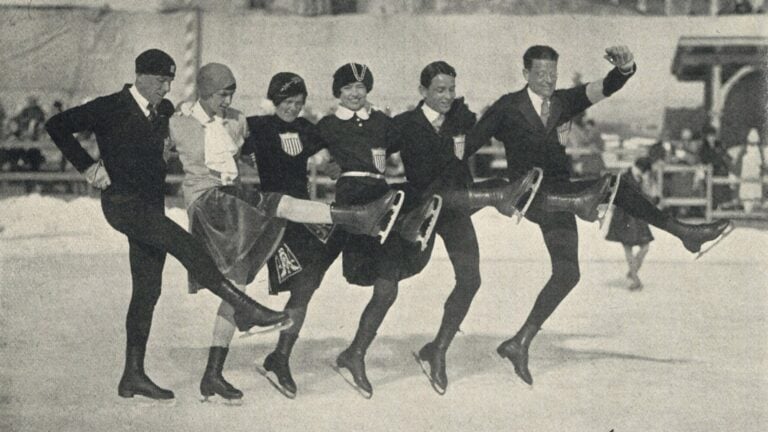
The United States figure skating team at the 1928 Winter Olympics. From left to right: Roger Turner, Maribel Vinson, Beatrix Loughran, Theresa Blanchard, Sherwin Badger, Nathaniel Niles (Photo: See page for author, Public domain, via Wikimedia Commons)
As the 2026 Winter Olympics come to a close, one sport continued to showcase artistry as well as athleticism: figure skating. But after more than a century of strict music regulations, figure skaters are branching out into a whole new musical soundscape. ... Classical music has been the standard for figure skating ever since the sport first debuted during the 1908 London Games. In fact, music with lyrics was actively banned by the International Skating Union: it was thought that lyrics might distract skaters and audiences alike from athletes’ performances.
As the sport grew more popular, figure skating routines began to use classical pieces that were popular off the ice as well. Some of the most commonly used tracks historically have been compositions like Ravel’s Bolero, Tchaikovsky’s Swan Lake or The Nutcracker, and Gershwin’s Rhapsody in Blue. Bizet’s Carmen was at the center of some drama a few decades ago when, during the 1988 Olympics, East German Katherina Witt and American Debi Thomas each used the same excerpt in their long programs. The ensuing rivalry was dubbed the “Battle of the Carmens” as both skaters competed for Olympic gold (Witt ultimately won.)
Other classical music juggernauts are indelibly linked to the Games. In 1984, British ice dancers Jayne Torvill and Christopher Dean became the first non-Russians to take Olympic gold, dancing to a four-minute, 28-second cut of Ravel’s Boléro. Olympic champion Michelle Kwan made her debut at just 17 years old skating to a harp concerto called Lyra Angelica, while Yuna Kim brought the first figure skating Olympic gold home to South Korea for skating to Gerswin’s Piano Concerto in F.
{YT video; I'll get the URL}
All of this started to change in 1988, when Ice Dance became the first figure skating category to allow lyrics, but it wasn’t until the PyeongChang Olympics in 2018 that athletes across every figure skating discipline were allowed to use music with lyrics in their performances.
{snip}
Figure Skating’s Classical Music Connection
By Adela Skowronski | February 20, 2026
The United States figure skating team at the 1928 Winter Olympics. From left to right: Roger Turner, Maribel Vinson, Beatrix Loughran, Theresa Blanchard, Sherwin Badger, Nathaniel Niles (Photo: See page for author, Public domain, via Wikimedia Commons)
As the 2026 Winter Olympics come to a close, one sport continued to showcase artistry as well as athleticism: figure skating. But after more than a century of strict music regulations, figure skaters are branching out into a whole new musical soundscape. ... Classical music has been the standard for figure skating ever since the sport first debuted during the 1908 London Games. In fact, music with lyrics was actively banned by the International Skating Union: it was thought that lyrics might distract skaters and audiences alike from athletes’ performances.
As the sport grew more popular, figure skating routines began to use classical pieces that were popular off the ice as well. Some of the most commonly used tracks historically have been compositions like Ravel’s Bolero, Tchaikovsky’s Swan Lake or The Nutcracker, and Gershwin’s Rhapsody in Blue. Bizet’s Carmen was at the center of some drama a few decades ago when, during the 1988 Olympics, East German Katherina Witt and American Debi Thomas each used the same excerpt in their long programs. The ensuing rivalry was dubbed the “Battle of the Carmens” as both skaters competed for Olympic gold (Witt ultimately won.)
Other classical music juggernauts are indelibly linked to the Games. In 1984, British ice dancers Jayne Torvill and Christopher Dean became the first non-Russians to take Olympic gold, dancing to a four-minute, 28-second cut of Ravel’s Boléro. Olympic champion Michelle Kwan made her debut at just 17 years old skating to a harp concerto called Lyra Angelica, while Yuna Kim brought the first figure skating Olympic gold home to South Korea for skating to Gerswin’s Piano Concerto in F.
{YT video; I'll get the URL}
All of this started to change in 1988, when Ice Dance became the first figure skating category to allow lyrics, but it wasn’t until the PyeongChang Olympics in 2018 that athletes across every figure skating discipline were allowed to use music with lyrics in their performances.
{snip}
2 replies
 = new reply since forum marked as read
Highlight:
NoneDon't highlight anything
5 newestHighlight 5 most recent replies
= new reply since forum marked as read
Highlight:
NoneDon't highlight anything
5 newestHighlight 5 most recent replies
= new reply since forum marked as read
Highlight:
NoneDon't highlight anything
5 newestHighlight 5 most recent replies
Figure Skating's Classical Music Connection (Original Post)
mahatmakanejeeves
Feb 21
OP

hlthe2b
(114,086 posts)1. True enough, but a lot of disco music this time around as well.
When they do classical I appreciate the selections I know. Those I do not leave me a bit frustrated since I have yet to find anywhere that lists the selections used by each skater. (That goes for non-classical music as well). Still, classical has been and remains the hallmark of figure skating background music selections. Granted, part of that is the comparative ease of getting necessary approvals since much has non-copyright options.

SCantiGOP
(14,727 posts)2. My first classical music exposure
Came from Saturday morning cartoons