Washington
Related: About this forum
Op-Ed: Issaquah's Plan to Build Its Rail Line Faster and Cheaper
By Mark Mullet, Kelly Jiang and Kevin Nichols
Mark Mullet is the Mayor of Issaquah. Kelly Jiang and Kevin Nichols serve on the Issaquah City Council.
Sound Transit faces a $34 billion shortfall and a narrow window to decide what gets built. That is a problem. But it is also a chance to rethink how transit gets delivered in this region. Issaquah wants to show what that looks like: a line that costs less, a station area that generates ridership through housing rather than garages, and a city that is ready to share the work with Sound Transit rather than just make demands.
A cheaper line is a buildable line
The Bellevue-to-Issaquah corridor is one of the most straightforward segments in ST3. Most of the alignment can run at grade in the I-90 median, within the existing right-of-way owned by the Washington State Department of Transportation (WSDOT). That means lower land acquisition costs, simpler construction, and a fraction of the expense of the tunneled and elevated segments elsewhere in the system.
Our proposal starts with cutting parking garages. Structured parking is among the most expensive and least effective ways to generate ridership – a single garage can cost as much as an entire station. Eliminating garages from the project scope would free up substantial capital while producing a better outcome, because what replaces them (housing) matters more.
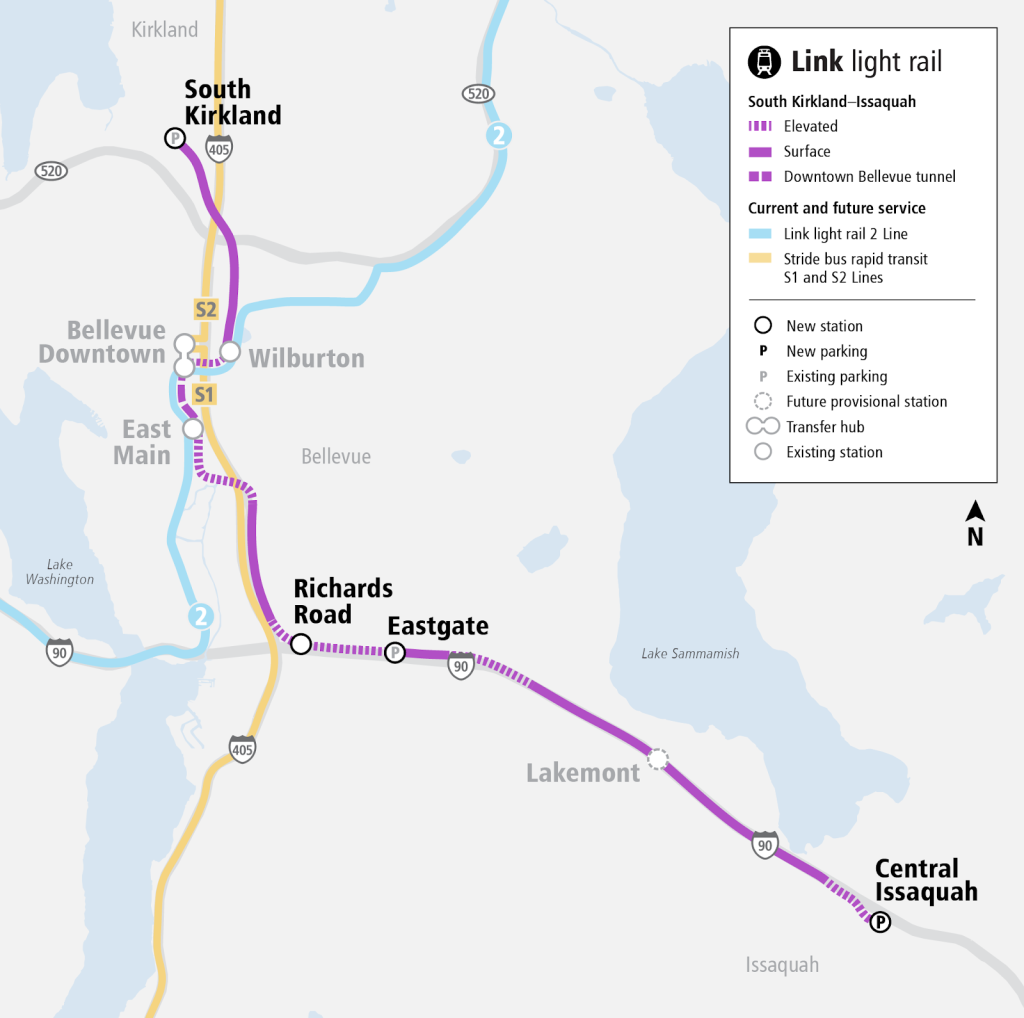
We are also prepared to partner directly with Sound Transit on project costs, including sharing the expense of land acquisition for construction staging. We have already begun working with Sound Transit staff, WSDOT, and the Puget Sound Regional Council to evaluate station area options, prioritizing cost and feasibility over perfection.
-more-
https://www.theurbanist.org/2026/02/23/op-ed-issaquahs-plan-to-build-its-rail-line-faster-and-cheaper/
 = new reply since forum marked as read
Highlight:
NoneDon't highlight anything
5 newestHighlight 5 most recent replies
= new reply since forum marked as read
Highlight:
NoneDon't highlight anything
5 newestHighlight 5 most recent replies

LisaM
(29,580 posts)By taking away parking, that mean that people need to get to the transit centers by other means, generally infrequent buses that don't always go to the actual station. This is a problem when it's late at night, when it's bad weather, if you are carrying packages, if you are disabled or elderly, or sometimes just being a woman riding alone. It also lengthens the trip because you have to switch from one train or bus to another. Sound Transit has added huge amounts of time to my commute. My 11-15 minute bus ride downtown can now take up to 40 minutes. That's a significant difference.
Of course, they make up for lack of parking by not having enough seating on the light rail. Half the people riding in the morning have to stand. Again, that's a problem if you are carrying anything. I like to stop at the grocery when I go into the office and juggling my laptop and a bag of groceries is really difficult when I have to stand.