Environment & Energy
Related: About this forum
Solar Arrays Are A Health Threat, Because Electromagnetic Fields, Or Toxic Runoff Or . . Something
EDIT
Still, a state board in Ohio rejected an application for a solar project last month, citing local opposition, even though its staff initially said it met all requirements. Along with other concerns, according to the board, opponents “testified about the potential impacts on the health of residents.” A bill in Missouri would halt commercial solar projects in the state, including those under construction, through at least 2027, as a state agency develops new regulations. The bill’s emergency clause says this is “deemed necessary for the immediate preservation of the public health, welfare, peace, and safety.”
And, on the eastern edge of Michigan, St. Clair County adopted a novel public health regulation last year that set limits on solar development and battery storage. The move was encouraged by the county’s medical director who, in a memo, warned of the threat of noise, visual pollution and potential sources of contamination. Some local residents have long pressed leaders to act, saying that intrusive noise could worsen post-traumatic stress disorder and other ailments. Public officials don’t always examine the validity of health claims, according to Rule. And local deliberations rarely compare the impact of solar farms to common agricultural practices, which can lead to runoff from fertilizers and herbicides, for example, or waste lagoons from concentrated animal feeding operations.
EDIT
While the future farmability of the land is often a concern, many researchers — and farmers — say that a solar lease will help preserve it.With proper planning on the front end, equipment can be removed from a decommissioned solar site and green space restored, said Steve Kalland, executive director of the NC Clean Energy Technology Center, which, along with its partners, provides technical assistance to local governments in the Carolinas. And a person’s exposure to the electromagnetic field, or EMF, from a solar farm is roughly the same as what they would encounter from ordinary household appliances, according to researchers. EMF levels also decrease rapidly with distance.
Chronic exposure to noise is also a recurring complaint from critics. In challenging a proposed project from Adair’s company in Morrow County, Ohio, one woman said in a brief to the state siting board that she was troubled about how noise from the facility might affect people with neurological noise sensitivities, including her daughter. A piece of equipment called an inverter is usually the source of noise on a solar site. It converts the current into the form that’s used on the grid. But noise, as well as glare, are typically buffered with vegetative landscaping and setbacks, or the distance between the property line and the nearest structure. Inverters can also be placed far from the ears of neighbors.
EDIT
https://www.propublica.org/article/michigan-solar-farms-health-concerns-st-clair-county
 = new reply since forum marked as read
Highlight:
NoneDon't highlight anything
5 newestHighlight 5 most recent replies
= new reply since forum marked as read
Highlight:
NoneDon't highlight anything
5 newestHighlight 5 most recent replies

GiqueCee
(4,529 posts)... with little or no basis in fact, are almost certainly generated by shills for the fossil fuel industry.

OKIsItJustMe
(21,919 posts)NNadir often posts about the (supposed) environmental horrors of renewable energy:
https://www.democraticunderground.com/1127184092
…
The paper gives some details of the rather nasty chemistry of solar cell manufacture (of course while declaring the exercise "green" ) which includes, as I was already aware the use of hydrofluoric acid. I consider hydrofluoric acid to be the most scary chemical with which I've worked, and I worked with the war gas phosgene, lots of it.
…
So called "renewable energy" is mass intensive, highly dependent on vast mining enterprises. Mercury is not used directly in solar cells, but is an artifact of the mining of the other metals in these cells, in CIGS solar cells, copper, indium, gallium as well the toxic relatively rare nonmetal element selenium, which is an artifact of copper mining, and is recovered from the anode sludge.
…
GiqueCee
(4,529 posts)... and we all have to come to terms with the irrefutable fact that manufacturing anything has its environmental downside. The potential toxicity of elements used in making solar cells has to be weighed against the well-known damage to the environment and the air we breathe caused by refining and burning fossil fuels.
This is the only planet we've got, and, in all likelihood, the only planet we'll ever have. Even if there are other habitable planets – and it's statistically impossible for there not to be – in even our own galaxy, never mind any of the other billions of galaxies out there, they are far, far too distant for us to get to them. SO. It behooves us to do anything and everything possible with the resources presently available to mitigate the proven harm fossil fuels inflict, while at the same time working to minimize the harm that manufacturing alternative power sources may pose. Everything's a trade-off.
Responsible stewardship of Mother Earth and its resources is the most important thing that we, as human beings, will ever undertake. But try telling that to the psychotic corporatists that know the harm they're causing, including the harm they're inflicting on their own children as well as ours, they just don't give shit. Money trumps everything. (Pun intended)
Hope I cheered you up! Have a nice day.
OKIsItJustMe
(21,919 posts)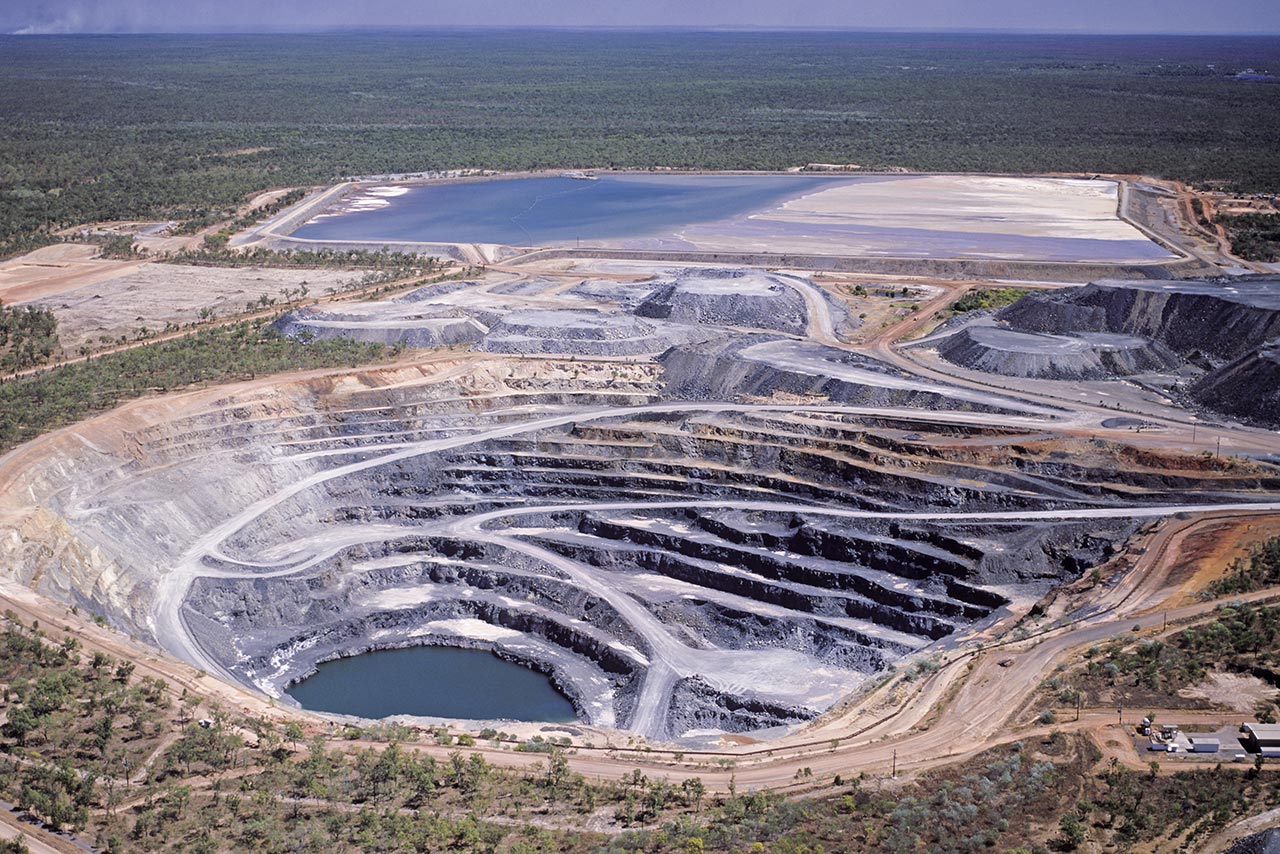

thought crime
(1,725 posts)Keep those pesky humans out of here...
GiqueCee
(4,529 posts)... that's a helluva hole, ain't it?
OKIsItJustMe
(21,919 posts)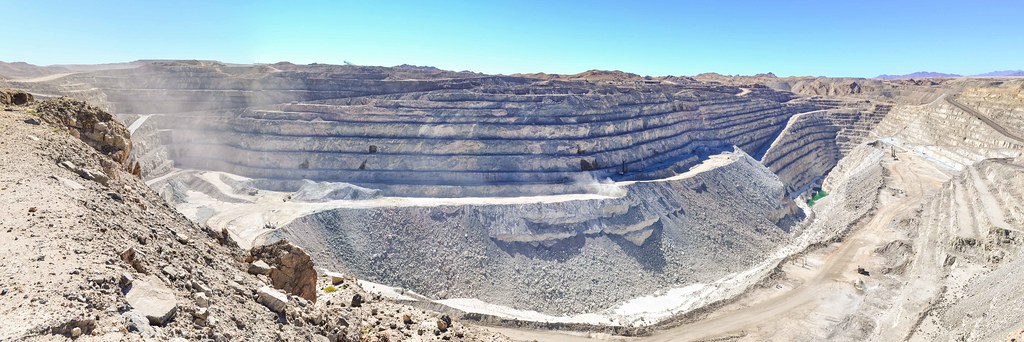
GiqueCee
(4,529 posts)... there are vast swathes of the West that are denuded and defiled to mine for minerals of every sort. But people ain't gonna give up their goodies just to save the planet. As I've observed many times, they all think, "What has posterity ever done for me?"
Just as the don't want to hear, "Hey, we're gonna eat dead pig for supper!" rather than delicious pork chops smothered in onion gravy, they'd rather not know that their cell phones require the mining of rare ores and chemicals that leave such monstrous holes in the ground that will never be backfilled and replanted.
Oh! I gotta take this call! 
OKIsItJustMe
(21,919 posts)Uranium (U), although very dense (19.1 grams per cubic centimeter), is a relatively weak, nonrefractory metal. Indeed, the metallic properties of uranium appear to be intermediate between those of silver and other true metals and those of the nonmetallic elements, so that it is not valued for structural applications. The principal value of uranium is in the radioactive and fissionable properties of its isotopes. In nature, almost all (99.27 percent) of the metal consists of uranium-238; the remainder consists of uranium-235 (0.72 percent) and uranium-234 (0.006 percent). Of these naturally occurring isotopes, only uranium-235 is directly fissionable by neutron irradiation. However, uranium-238, upon absorbing a neutron, forms uranium-239, and this latter isotope eventually decays into plutonium-239—a fissile material of great importance in nuclear power and nuclear weapons. Another fissile isotope, uranium-233, can be formed by neutron irradiation of thorium-232.
Extraction and refining
…
Leaching
…
Acid leaching is commonly performed by agitating an ore-leach mixture for 4 to as long as 48 hours at ambient temperature. Except in special circumstances, sulfuric acid is the leachant used; it is supplied in amounts sufficient to obtain a final leach liquor at about pH 1.5. Sulfuric acid leaching circuits commonly employ either manganese dioxide or chlorate ion to oxidize the tetravalent uranium ion (U⁴⁺) to the hexavalent uranyl ion (UO₂²⁺). Typically, about 5 kilograms (11 pounds) of manganese dioxide or 1.5 kilograms of sodium chlorate per ton suffice to oxidize tetravalent uranium. In any case, the oxidized uranium reacts with the sulfuric acid to form a uranyl sulfate complex anion, [UO₂(SO)₃]⁴⁻.
Uranium ores that contain significant amounts of basic minerals such as calcite or dolomite are leached with 0.5 to 1 molar sodium carbonate solutions. Although a variety of reagents has been studied and tested, oxygen is the uranium oxidant of choice. Typically, candidate ores are leached in air at atmospheric pressure and at 75 to 80 °C (167 to 175 °F) for periods that vary with the particular ore. The alkaline leachant reacts with uranium to form a readily soluble uranyl carbonate complex ion, [UO₂(CO₃)₃]⁴⁺.
Prior to further processing, solutions resulting from either acidic or carbonate leaching must be clarified. Large-scale separation of clays and other ore slimes is accomplished through the use of effective flocculants, including polyacrylamides, guar gum, and animal glue.
…
thought crime
(1,725 posts)It shouldn't be this way. Clean energy advocates should work together or at least not fight against each other. But some "nuclear brothers" infest online discussion forums with a Zero-sum approach to bash renewable energy. They believe investments in renewable energy are somehow hurting nuclear energy. Pure paranoia that rivals climate denial.
Wonder Why
(7,188 posts)
thought crime
(1,725 posts)Therefore Solar Energy causes cancer. 
thought crime
(1,725 posts)Meanwhile, the hellscape of urban sprawl catering to an insane car-culture is warmly embraced throughout the country, with exceptions made for affluent areas reserved for the sensitive rich.

hunter
(40,789 posts)Fields of solar panels really are ugly. Personally, they do not give me any warm fuzzy feelings.
If people want to put solar panels on their roofs or over their parking lots it doesn't bother me so long as lower income people don't end up subsidizing this.
Sometime there are good reasons to oppose large solar projects. Anti-woke and woo are not among them.
OKIsItJustMe
(21,919 posts)For construction, a company comes in installs a bunch of panels, a battery backup, equipment for interconnection with the grid. It can be done relatively quickly. Thanks to “economies of scale” all of the hardware is less expensive as well.
Maintenance can be provided by a small team, rather than traveling around to individual homes. Here’s part of the team that maintains “my” solar panels. I’d hate to see them climbing up on roofs all day long…
https://duckduckgo.com/?q=solar+grazing&iar=videos
Some people are concerned about changing a farmer’s fields into a “solar farm.” I’d be much more concerned about growing crops for “biofuels.” And, as it turns out growing crops and producing electricity are not mutually exclusive.
https://en.wikipedia.org/wiki/Agrivoltaics
https://duckduckgo.com/?q=agrvoltaics&iar=videos
https://www.nature.com/articles/d41586-026-01195-3
15 April 2026
What China’s Great Green Wall can teach the world
Efforts to boost tree cover and restore degraded land globally need stable funding and time to learn from failure.
In Nature this week, researchers describe an initiative that is greening some of the world’s drylands — including deserts, shrublands and other water-scarce regions. The Great Green Wall of China, officially called the Three-North Shelterbelt programme, is one of the largest and longest-running projects of its kind. Outside China, the initiative is less well known than other programmes, such as Africa’s Great Green Wall. But, as Lilin Zheng, a researcher in geographical information systems at Shanghai Jiao Tong University’s School of Design in China and colleagues write, the project is succeeding whereas other green-wall initiatives are struggling. The programme’s strategies need to be studied — not only for land-restoration initiatives elsewhere in China, but also for those in other parts of the world, such as Africa.
…
For around a decade now, China’s desert regions have been home to large solar-power and wind farms. Green-wall planners are now planting vegetation around these renewable-energy facilities. The solar panels also provide shade, trap moisture, lower ground temperatures and help to reduce evaporation (Z. Xia et al. J. Environ. Manag. 324, 116338; 2022).
…