Welcome to DU!
The truly grassroots left-of-center political community where regular people, not algorithms, drive the discussions and set the standards.
Join the community:
Create a free account
Support DU (and get rid of ads!):
Become a Star Member
Latest Breaking News
Editorials & Other Articles
General Discussion
The DU Lounge
All Forums
Issue Forums
Culture Forums
Alliance Forums
Region Forums
Support Forums
Help & Search
Environment & Energy
Related: About this forumScientists Identify Hidden Accelerant in Antarctic Ice Loss
https://cmns.umd.edu/news-events/news/madeleine-youngs-scientists-identify-hidden-accelerant-antarctic-ice-loss15 May 2026
A new UMD-led study shows that meltwater flowing off ice shelves changes the ocean in ways that drive even faster melting—and most global climate projections don’t even include it.
For years, scientists have warned that melting Antarctic ice could push sea levels dangerously higher by the end of this century. But a new study led by University of Maryland scientist Madeleine Youngs suggests those warnings may still be too conservative because they leave out a crucial factor: the ocean’s own complex circulatory system.
Youngs’ research team found that when ice melts into the ocean, it doesn’t just raise sea levels—it also changes how the ocean circulates, which in turn changes how much ice melts. The team’s study, published in the journal Nature Geoscience on May 15, 2026, revealed that this self-reinforcing chain reaction may contribute as much to rising sea levels as the direct effects of a warming atmosphere.
“Most current climate models that inform international policy don’t consider this feedback loop at all. The Intergovernmental Panel on Climate Change (IPCC) treats melting as a fixed, rather than interactive input,” explained Youngs, the study’s lead author and an assistant professor in UMD’s Department of Atmospheric and Oceanic Science. “We need to include ice shelf melt feedbacks when we’re estimating future ice shelf melt, the primary component of sea level rise, if we want the most accurate understanding of what’s going on.”
The key to understanding why meltwater has such an outsized effect comes down to water temperature and density. Cold, dense water naturally sinks and forms a barrier layer near the ocean floor that keeps warmer deep-ocean currents from reaching the base of ice shelves. When meltwater flows in, it dilutes and weakens that cold barrier—allowing warmer water to push through and melt the ice from below. More melting produces more freshwater, which further weakens the barrier and lets in more warm water. The cycle feeds itself.
…
Youngs, M.K., Stewart, A.L., Si, Y. et al. Antarctic ice-shelf basal melt shaped by competing feedbacks. Nat. Geosci. (2026). https://doi.org/10.1038/s41561-026-01975-6A new UMD-led study shows that meltwater flowing off ice shelves changes the ocean in ways that drive even faster melting—and most global climate projections don’t even include it.
For years, scientists have warned that melting Antarctic ice could push sea levels dangerously higher by the end of this century. But a new study led by University of Maryland scientist Madeleine Youngs suggests those warnings may still be too conservative because they leave out a crucial factor: the ocean’s own complex circulatory system.
Youngs’ research team found that when ice melts into the ocean, it doesn’t just raise sea levels—it also changes how the ocean circulates, which in turn changes how much ice melts. The team’s study, published in the journal Nature Geoscience on May 15, 2026, revealed that this self-reinforcing chain reaction may contribute as much to rising sea levels as the direct effects of a warming atmosphere.
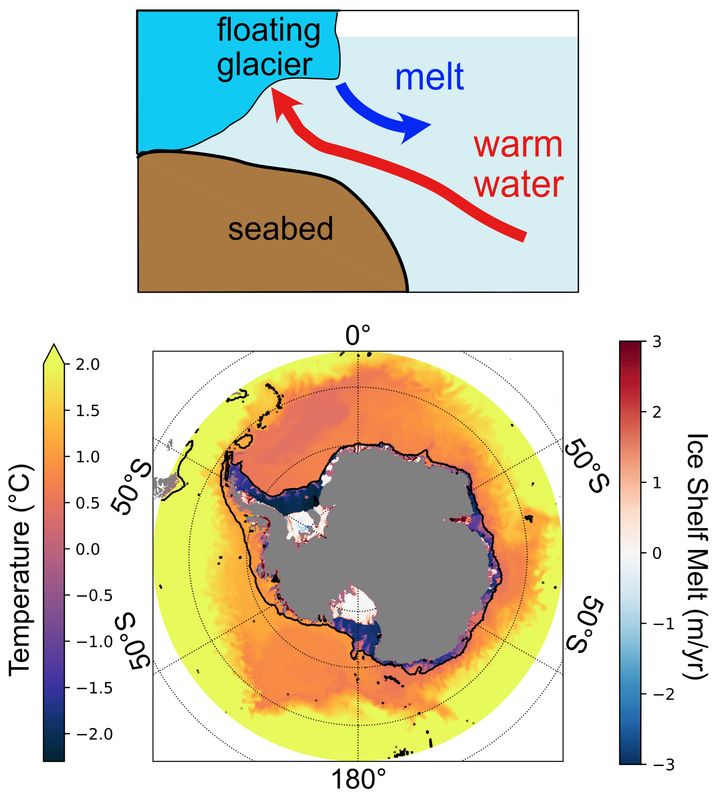
Top: A diagram illustrating the Antarctic ice shelf melt interactions between a floating glacier and warm water. Bottom: A heat map depicting the temperatures of the Antarctic ice shelf. Credit: Madeleine Youngs.
“Most current climate models that inform international policy don’t consider this feedback loop at all. The Intergovernmental Panel on Climate Change (IPCC) treats melting as a fixed, rather than interactive input,” explained Youngs, the study’s lead author and an assistant professor in UMD’s Department of Atmospheric and Oceanic Science. “We need to include ice shelf melt feedbacks when we’re estimating future ice shelf melt, the primary component of sea level rise, if we want the most accurate understanding of what’s going on.”
The key to understanding why meltwater has such an outsized effect comes down to water temperature and density. Cold, dense water naturally sinks and forms a barrier layer near the ocean floor that keeps warmer deep-ocean currents from reaching the base of ice shelves. When meltwater flows in, it dilutes and weakens that cold barrier—allowing warmer water to push through and melt the ice from below. More melting produces more freshwater, which further weakens the barrier and lets in more warm water. The cycle feeds itself.
…
1 replies
 = new reply since forum marked as read
Highlight:
NoneDon't highlight anything
5 newestHighlight 5 most recent replies
= new reply since forum marked as read
Highlight:
NoneDon't highlight anything
5 newestHighlight 5 most recent replies
= new reply since forum marked as read
Highlight:
NoneDon't highlight anything
5 newestHighlight 5 most recent replies
Scientists Identify Hidden Accelerant in Antarctic Ice Loss (Original Post)
OKIsItJustMe
11 hrs ago
OP
Hansen, J. et al. Ice Melt, Sea Level Rise and Superstorms: Evidence from Paleoclimate Data...
OKIsItJustMe
5 hrs ago
#1

OKIsItJustMe
(22,075 posts)1. Hansen, J. et al. Ice Melt, Sea Level Rise and Superstorms: Evidence from Paleoclimate Data...
Hansen, J. et al. Ice Melt, Sea Level Rise and Superstorms: Evidence from Paleoclimate Data, Climate Modeling, and Modern Observations That 2 °C Global Warming Could Be Dangerous. Atmospheric Chemistry and Physics 16, 3761–3812 (2016). doi:10.5194/acp-16-3761-2016
…
Abstract. We use numerical climate simulations, paleoclimate data, and modern observations to study the effect of growing ice melt from Antarctica and Greenland. Meltwater tends to stabilize the ocean column, inducing amplifying feedbacks that increase subsurface ocean warming and ice shelf melting. Cold meltwater and induced dynamical effects cause ocean surface cooling in the Southern Ocean and North Atlantic, thus increasing Earth’s energy imbalance and heat flux into most of the global ocean’s surface. Southern Ocean surface cooling, while lower latitudes are warming, increases precipitation on the Southern Ocean, increasing ocean stratification, slowing deepwater formation, and increasing ice sheet mass loss. These feedbacks make ice sheets in contact with the ocean vulnerable to accelerating disintegration. We hypothesize that ice mass loss from the most vulnerable ice, sufficient to raise sea level several meters, is better approximated as exponential than by a more linear response. Doubling times of 10, 20 or 40 years yield multi-meter sea level rise in about 50, 100 or 200 years. Recent ice melt doubling times are near the lower end of the 10–40-year range, but the record is too short to confirm the nature of the response. The feedbacks, including subsurface ocean warming, help explain paleoclimate data and point to a dominant Southern Ocean role in controlling atmospheric CO₂, which in turn exercised tight control on global temperature and sea level. The millennial (500–2000-year) timescale of deep-ocean ventilation affects the timescale for natural CO₂ change and thus the timescale for paleo-global climate, ice sheet, and sea level changes, but this paleo-millennial timescale should not be misinterpreted as the timescale for ice sheet response to a rapid, large, human-made climate forcing. These climate feedbacks aid interpretation of events late in the prior interglacial, when sea level rose to +6–9 m with evidence of extreme storms while Earth was less than 1 ◦C warmer than today. Ice melt cooling of the North Atlantic and Southern oceans increases atmospheric temperature gradients, eddy kinetic energy and baroclinicity, thus driving more powerful storms. The modeling, paleoclimate evidence, and ongoing observations together imply that 2 ◦C global warming above the preindustrial level could be dangerous. Continued high fossil fuel emissions this century are predicted to yield (1) cooling of the Southern Ocean, especially in the Western Hemisphere; (2) slowing of the Southern Ocean overturning circulation, warming of the ice shelves, and growing ice sheet mass loss; (3) slowdown and eventual shutdown of the Atlantic overturning circulation with cooling of the North Atlantic region; (4) increasingly powerful storms; and (5) nonlinearly growing sea level rise, reaching several meters over a timescale of 50–150 years. These predictions, especially the cooling in the Southern Ocean and North Atlantic with markedly reduced warming or even cooling in Europe, differ fundamentally from existing climate change assessments. We discuss observations and modeling studies needed to refute or clarify these assertions.
…
Abstract. We use numerical climate simulations, paleoclimate data, and modern observations to study the effect of growing ice melt from Antarctica and Greenland. Meltwater tends to stabilize the ocean column, inducing amplifying feedbacks that increase subsurface ocean warming and ice shelf melting. Cold meltwater and induced dynamical effects cause ocean surface cooling in the Southern Ocean and North Atlantic, thus increasing Earth’s energy imbalance and heat flux into most of the global ocean’s surface. Southern Ocean surface cooling, while lower latitudes are warming, increases precipitation on the Southern Ocean, increasing ocean stratification, slowing deepwater formation, and increasing ice sheet mass loss. These feedbacks make ice sheets in contact with the ocean vulnerable to accelerating disintegration. We hypothesize that ice mass loss from the most vulnerable ice, sufficient to raise sea level several meters, is better approximated as exponential than by a more linear response. Doubling times of 10, 20 or 40 years yield multi-meter sea level rise in about 50, 100 or 200 years. Recent ice melt doubling times are near the lower end of the 10–40-year range, but the record is too short to confirm the nature of the response. The feedbacks, including subsurface ocean warming, help explain paleoclimate data and point to a dominant Southern Ocean role in controlling atmospheric CO₂, which in turn exercised tight control on global temperature and sea level. The millennial (500–2000-year) timescale of deep-ocean ventilation affects the timescale for natural CO₂ change and thus the timescale for paleo-global climate, ice sheet, and sea level changes, but this paleo-millennial timescale should not be misinterpreted as the timescale for ice sheet response to a rapid, large, human-made climate forcing. These climate feedbacks aid interpretation of events late in the prior interglacial, when sea level rose to +6–9 m with evidence of extreme storms while Earth was less than 1 ◦C warmer than today. Ice melt cooling of the North Atlantic and Southern oceans increases atmospheric temperature gradients, eddy kinetic energy and baroclinicity, thus driving more powerful storms. The modeling, paleoclimate evidence, and ongoing observations together imply that 2 ◦C global warming above the preindustrial level could be dangerous. Continued high fossil fuel emissions this century are predicted to yield (1) cooling of the Southern Ocean, especially in the Western Hemisphere; (2) slowing of the Southern Ocean overturning circulation, warming of the ice shelves, and growing ice sheet mass loss; (3) slowdown and eventual shutdown of the Atlantic overturning circulation with cooling of the North Atlantic region; (4) increasingly powerful storms; and (5) nonlinearly growing sea level rise, reaching several meters over a timescale of 50–150 years. These predictions, especially the cooling in the Southern Ocean and North Atlantic with markedly reduced warming or even cooling in Europe, differ fundamentally from existing climate change assessments. We discuss observations and modeling studies needed to refute or clarify these assertions.
…