Welcome to DU!
The truly grassroots left-of-center political community where regular people, not algorithms, drive the discussions and set the standards.
Join the community:
Create a free account
Support DU (and get rid of ads!):
Become a Star Member
Latest Breaking News
Editorials & Other Articles
General Discussion
The DU Lounge
All Forums
Issue Forums
Culture Forums
Alliance Forums
Region Forums
Support Forums
Help & Search
World History
Related: About this forum
On March 9, 1776, Adam Smith's "An Inquiry into the Nature and Causes of the Wealth of Nations" was published.
Opinion
This masterwork is turning 250. It’s needed now more than ever.
Adam Smith’s free-markets masterwork, published on March 9, 1776, was about much more than economics.
March 6, 2026
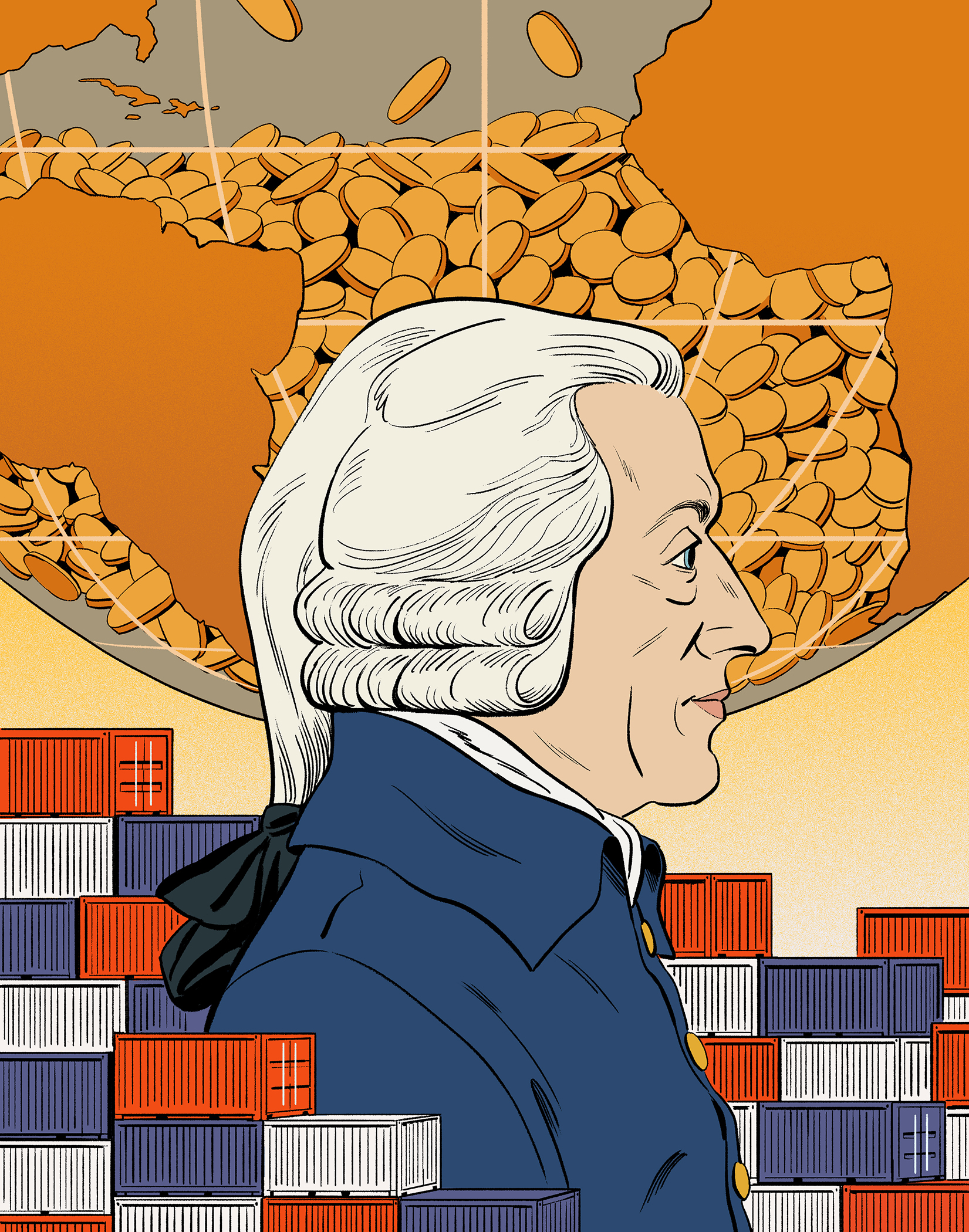
(Illustration by Chuan Ming Ong/For The Washington Post)
By Jesse Norman
Jesse Norman is the author of “Adam Smith: Father of Economics.” His new book on Adam Smith will be published later this year.
On March 9, 1776, four months before the American colonies broke with Britain over the issue of taxation, a little-known Scottish thinker published a long, dense book with an unpromising title: “An Inquiry into the Nature and Causes of the Wealth of Nations.”
Two hundred and fifty years later, Adam Smith is, by any objective measure, easily the most widely cited and widely quoted economist who ever lived. Astonishingly, his work still frames the central questions we face, not just about free markets, trade and capitalism, but about the nature of human society, and even what it is to be human at all.
Smith was born in 1723 in Kirkcaldy, Scotland, educated at the universities of Glasgow and Oxford, and initially made his name not as an economist but as a moral philosopher. His first published book, “The Theory of Moral Sentiments,” offered a radical theory of how we form moral judgments: radical, because it derived the creation of moral values not from scripture or divine grace, but from human sympathy and mutual regard.
“The Wealth of Nations,” as his second major work came to be known, was an extension of that project. The book is not, as sometimes believed, a hymn to greed, a paean to market fundamentalism and red-in-tooth-and-claw capitalism. It was an attempt to understand how a commercial society could generate prosperity without collapsing into corruption. ... This 250th anniversary is not a moment for hagiography. It is an opportunity to recover a way of thinking that is directly relevant, indeed urgent, to the economic, social and political challenges we face today.
{snip}
This masterwork is turning 250. It’s needed now more than ever.
Adam Smith’s free-markets masterwork, published on March 9, 1776, was about much more than economics.
March 6, 2026
(Illustration by Chuan Ming Ong/For The Washington Post)
By Jesse Norman
Jesse Norman is the author of “Adam Smith: Father of Economics.” His new book on Adam Smith will be published later this year.
On March 9, 1776, four months before the American colonies broke with Britain over the issue of taxation, a little-known Scottish thinker published a long, dense book with an unpromising title: “An Inquiry into the Nature and Causes of the Wealth of Nations.”
Two hundred and fifty years later, Adam Smith is, by any objective measure, easily the most widely cited and widely quoted economist who ever lived. Astonishingly, his work still frames the central questions we face, not just about free markets, trade and capitalism, but about the nature of human society, and even what it is to be human at all.
Smith was born in 1723 in Kirkcaldy, Scotland, educated at the universities of Glasgow and Oxford, and initially made his name not as an economist but as a moral philosopher. His first published book, “The Theory of Moral Sentiments,” offered a radical theory of how we form moral judgments: radical, because it derived the creation of moral values not from scripture or divine grace, but from human sympathy and mutual regard.
“The Wealth of Nations,” as his second major work came to be known, was an extension of that project. The book is not, as sometimes believed, a hymn to greed, a paean to market fundamentalism and red-in-tooth-and-claw capitalism. It was an attempt to understand how a commercial society could generate prosperity without collapsing into corruption. ... This 250th anniversary is not a moment for hagiography. It is an opportunity to recover a way of thinking that is directly relevant, indeed urgent, to the economic, social and political challenges we face today.
{snip}
The Wealth of Nations
Eamonn Butler's Condensed Wealth of Nations is available to download here.
The book's broad themes
The first theme in The Wealth of Nations is that regulations on commerce are ill-founded and counter-productive. The prevailing view was that gold and silver was wealth, and that countries should boost exports and resist imports in order to maximize this metal wealth. Smith’s radical insight was that a nation’s wealth is really the stream of goods and services that it creates. Today, we would call it gross national product. And the way to maximise it, he argued, was not to restrict the nation’s productive capacity, but to set it free.
Another central theme is that this productive capacity rests on the division of labour and the accumulation of capital that it makes possible. Huge efficiencies can be gained by breaking production down into many small tasks, each undertaken by specialist hands. This leaves producers with a surplus that they can exchange with others, or use to invest in new and even more efficient labour-saving machinery.
Smith’s third theme is that a country’s future income depends upon this capital accumulation. The more that is invested in better productive processes, the more wealth will be created in the future. But if people are going to build up their capital, they must be confident that it will be secure from theft. The countries that prosper are those that grow their capital, manage it well, and protect it.
A fourth theme is that this system is automatic. Where things are scarce, people are prepared to pay more for them: there is more profit in supplying them, so producers invest more capital to produce them. Where there is a glut, prices and profits are low, producers switch their capital and enterprise elsewhere. Industry thus remains focused on the nation’s most important needs, without the need for central direction. ... But the system is automatic only when there is free trade and competition. When governments grant subsidies or monopolies to favoured producers, or shelter them behind tariff walls, they can charge higher prices. The poor suffer most from this, facing higher costs for the necessities that they rely on.
A further theme of The Wealth Of Nations is that competition and free exchange are under threat from the monopolies, tax preferences, controls, and other privileges that producers extract from the government authorities. ... For all these reasons, Smith believes that government itself must be limited. Its core functions are maintaining defence, keeping order, building infrastructure and promoting education. It should keep the market economy open and free, and not act in ways that distort it.
{snip}
Eamonn Butler's Condensed Wealth of Nations is available to download here.
The book's broad themes
The first theme in The Wealth of Nations is that regulations on commerce are ill-founded and counter-productive. The prevailing view was that gold and silver was wealth, and that countries should boost exports and resist imports in order to maximize this metal wealth. Smith’s radical insight was that a nation’s wealth is really the stream of goods and services that it creates. Today, we would call it gross national product. And the way to maximise it, he argued, was not to restrict the nation’s productive capacity, but to set it free.
Another central theme is that this productive capacity rests on the division of labour and the accumulation of capital that it makes possible. Huge efficiencies can be gained by breaking production down into many small tasks, each undertaken by specialist hands. This leaves producers with a surplus that they can exchange with others, or use to invest in new and even more efficient labour-saving machinery.
Smith’s third theme is that a country’s future income depends upon this capital accumulation. The more that is invested in better productive processes, the more wealth will be created in the future. But if people are going to build up their capital, they must be confident that it will be secure from theft. The countries that prosper are those that grow their capital, manage it well, and protect it.
A fourth theme is that this system is automatic. Where things are scarce, people are prepared to pay more for them: there is more profit in supplying them, so producers invest more capital to produce them. Where there is a glut, prices and profits are low, producers switch their capital and enterprise elsewhere. Industry thus remains focused on the nation’s most important needs, without the need for central direction. ... But the system is automatic only when there is free trade and competition. When governments grant subsidies or monopolies to favoured producers, or shelter them behind tariff walls, they can charge higher prices. The poor suffer most from this, facing higher costs for the necessities that they rely on.
A further theme of The Wealth Of Nations is that competition and free exchange are under threat from the monopolies, tax preferences, controls, and other privileges that producers extract from the government authorities. ... For all these reasons, Smith believes that government itself must be limited. Its core functions are maintaining defence, keeping order, building infrastructure and promoting education. It should keep the market economy open and free, and not act in ways that distort it.
{snip}