Welcome to DU!
The truly grassroots left-of-center political community where regular people, not algorithms, drive the discussions and set the standards.
Join the community:
Create a free account
Support DU (and get rid of ads!):
Become a Star Member
Latest Breaking News
Editorials & Other Articles
General Discussion
The DU Lounge
All Forums
Issue Forums
Culture Forums
Alliance Forums
Region Forums
Support Forums
Help & Search
Science
Related: About this forum
A secretive Chinese probe has just arrived at one of Earth's 'quasi-moons' and will soon attempt a first-of-its-kind lan
A secretive Chinese probe has just arrived at one of Earth's 'quasi-moons' and will soon attempt a first-of-its-kind landingChina's Tianwen-2 mission has arrived at the quasi-moon Kamo'oalewa, which orbits the sun alongside Earth. The secretive probe will scoop up samples from our temporary companion to help uncover its mysterious origin, experts say.
By Harry Baker
published 4 hours ago
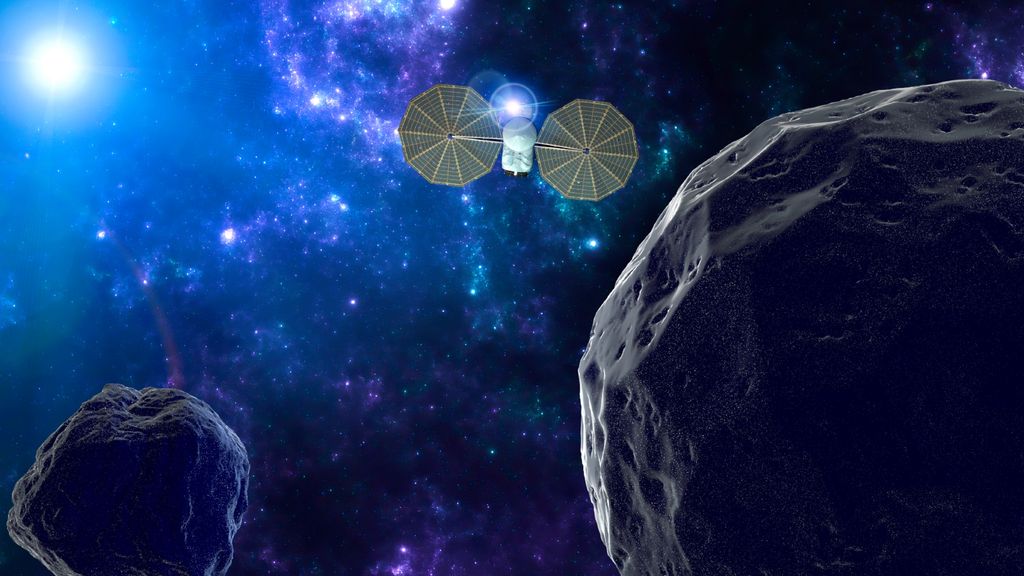
China's Tianwen-2 probe, which bears a striking resemblance to NASA's Lucy spacecraft (pictured in this illustration), has arrived at Earth's quasi-moon Kamo'oalewa and will soon attempt to land on the mysterious space rock.
(Image credit: Naeblys via Getty Images)
A Chinese spacecraft has arrived at one of Earth's temporary "quasi-moons" and will soon attempt to land on the space rock to scoop up samples that will be returned to our planet next year. The ambitious mission could help researchers uncover secrets about Earth's main moon and provide clues that may benefit space exploration and planetary defense, experts say.
The Chinese National Space Agency (CNSA) probe, named Tianwen-2, launched from Xichang Satellite Launch Center in southern China on May 28, 2025, Live Science's sister site Space.com reported at the time. The car-sized spacecraft sent back its first images a few weeks later, giving us our first glimpse of its secretive design, followed by a selfie with Earth a few months later.
The mission's primary target is 469219 Kamo'oalewa — also known as 2016 HO3 or simply Kamo'oalewa — a near-Earth asteroid discovered in 2016 by astronomers at Hawaii's Haleakala Observatory. It likely spans somewhere between 130 and 330 feet (40 to 100 meters) across and is a "quasi-satellite" of our planet, meaning it's orbiting the sun right alongside Earth in a temporary partnership. (Kamo'oalewa means "oscillating celestial fragment" in Hawaiian.)
Tianwen-2 is predicted to have arrived at Kamo'oalewa on June 7 and inserted itself into an orbit alongside the asteroid, according to an unverified timeline shared by freelance journalist Andrew Jones, a leading expert on China's space program. Around a month later, on July 4, the probe is expected to descend upon the space rock to collect samples from its surface, potentially employing a never-before-seen drilling technique to do so. (The CNSA has not released an official timeline for the mission or shared any recent updates about its progress.)
More:
https://www.livescience.com/space/space-exploration/a-secretive-chinese-probe-has-just-arrived-at-one-of-earths-quasi-moons-and-will-soon-attempt-a-first-of-its-kind-landing
Or:
https://archive.is/20260617174321/https://www.livescience.com/space/space-exploration/a-secretive-chinese-probe-has-just-arrived-at-one-of-earths-quasi-moons-and-will-soon-attempt-a-first-of-its-kind-landing#selection-2729.0-2741.352
5 replies
 = new reply since forum marked as read
Highlight:
NoneDon't highlight anything
5 newestHighlight 5 most recent replies
= new reply since forum marked as read
Highlight:
NoneDon't highlight anything
5 newestHighlight 5 most recent replies
= new reply since forum marked as read
Highlight:
NoneDon't highlight anything
5 newestHighlight 5 most recent replies
A secretive Chinese probe has just arrived at one of Earth's 'quasi-moons' and will soon attempt a first-of-its-kind lan (Original Post)
Judi Lynn
Jun 17
OP
I did not know that the Hawaiian language had a word for "occillating celestial fragment".
FadedMullet
Jun 17
#2
Of course it does! A truly inspired reference to Hawaiian culture. What was I thinking?
FadedMullet
Jun 18
#5

Klarkashton
(5,571 posts)1. While we bomb and kill and build ballrooms and other
Worthless shit.
FadedMullet
(1,169 posts)2. I did not know that the Hawaiian language had a word for "occillating celestial fragment".

El Supremo
(20,447 posts)3. Sure it does. Here is the first picture:

FadedMullet
(1,169 posts)5. Of course it does! A truly inspired reference to Hawaiian culture. What was I thinking?

SheltieLover
(83,117 posts)4. I didn't either!
Cool word. Aloha 