Anthropology
Related: About this forumHumans have been gambling since the Ice Age
April 2, 2026
4 min read
A new archeological finding shows that Native Americans were exploring probability through games of chance far earlier than their Old World counterparts
By Joseph Howlett edited by Lee Billings
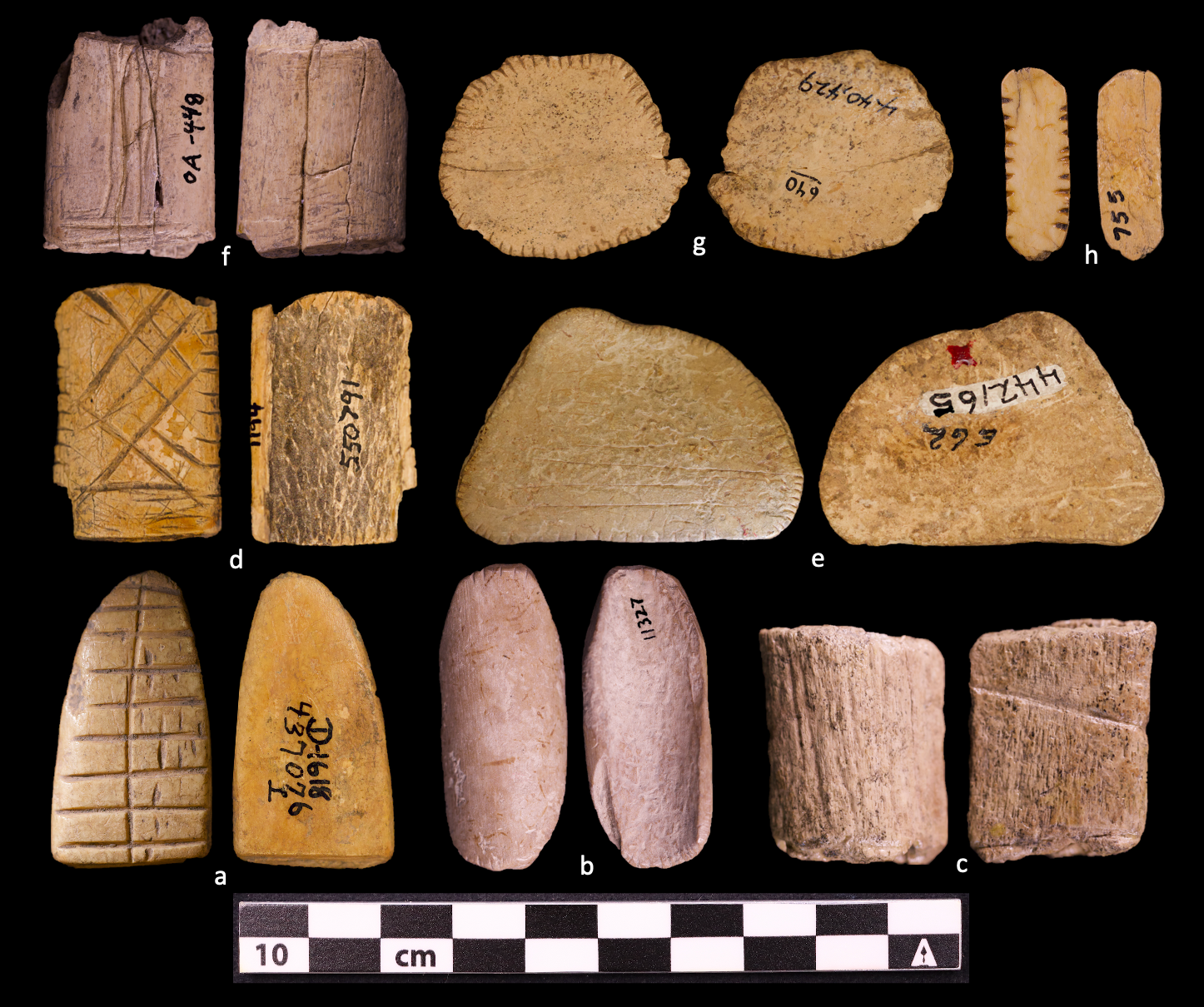
Various prehistoric dice and game pieces found across North America.
Humans played games using two-sided dice like these for millennia longer than archaeologists previously knew, according to a new study published today. Robert Madden
The history of gambling goes back way further than anyone imagined. This new discovery drastically alters the date of a key intellectual moment in the history of human culture—the recognition that some events in nature are random, under nobody’s control.
All games of chance, from Yahtzee to horse race betting, rely on probability, a relatively unintuitive concept. So archaeologists have taken care to document early examples, including dice used for games played by North Americans as early as 2,000 years ago. They’ve uncovered similar-seeming objects at even more ancient sites, but these pieces were individually too tiny and nondescript, and too isolated in the archaeological record, to identify with any certainty.
A new analysis by archaeologist Robert J. Madden, published today in the journal American Antiquity, changes that. Madden combed through this sparse record, confirming the oldest-known dice and establishing an unbroken, previously hidden lineage of chance-based games dating back at least 12,000 years, 6,000 before any counterpart in the Old World.
“This is the most exciting paper I’ve seen in North American archaeology in at least the last five years,” says Robert Weiner, an archaeologist at Dartmouth College. “Demonstrating this Native American contribution to global intellectual history is fantastic.”
More:
https://www.scientificamerican.com/article/humans-have-been-gambling-since-the-ice-age/
 = new reply since forum marked as read
Highlight:
NoneDon't highlight anything
5 newestHighlight 5 most recent replies
= new reply since forum marked as read
Highlight:
NoneDon't highlight anything
5 newestHighlight 5 most recent replies

Norrrm
(5,625 posts)They understood that probability could be improved.


Judi Lynn
(164,173 posts)April 2, 2026
by Colorado State University
edited by Stephanie Baum, reviewed by Robert Egan
Editors' notes
The GIST

1 / 1Late Pleistocene (13,000 to 11,700 BP), Early Holocene (11,700 to 8,000 BP), Middle Holocene (8,000 to 2,000 BP), and Late Holocene (2,000 to 450 BP) diagnostic and probable prehistoric Native American dice: (a, d) Signal Butte, Nebraska (Middle Holocene), NMNH-A437076, NMNH-550791; (b) Agate Basin, Wyoming (Early Holocene), UW-11327; (c, f) Agate Basin, Wyoming (Late Pleistocene), UW-OA111, UW-OA448; (e, g) Lindenmeier, Colorado (Late Pleistocene), NMNH-A442165, NMNHA440429; (h) Irvine, Wyoming (Late Holocene). (Figures 1a, d, e, and g courtesy of the Division of Anthropology, Smithsonian Institution, American Museum of Natural History. Figures 1b, c, f, and h courtesy of the Department of Anthropology, University of Wyoming.). Credit: Robert Madden
A new study in American Antiquity presents evidence that the earliest known dice in human history were made and used by Native American hunter-gatherers on the western Great Plains more than 12,000 years ago at the end of the last Ice Age, long before the earliest known dice from Bronze Age societies in the Old World.
The research conducted by Colorado State University Ph.D. student Robert J. Madden indicates that dice, games of chance, and gambling have been a persistent feature of Native American culture for at least the last 12,000 years, with the earliest examples appearing at Late Pleistocene Folsom-period archaeological sites in Wyoming, Colorado, and New Mexico. These artifacts predate the earliest known Old World dice by more than 6,000 years.
"Historians have traditionally treated dice and probability as Old World innovations," Madden said. "What the archaeological record shows is that ancient Native American groups were deliberately making objects designed to produce random outcomes, and using those outcomes in structured games, thousands of years earlier than previously recognized."

Folsom diagnostic and probable Native American dice. (Figure 9a, b, d, and g: Agate Basin, Wyoming, UW-OA005, UW-OA109, UW-OA111, UW-OA448, courtesy of the Department of Anthropology, University of Wyoming. Figure 9c: Lindenmeier, Colorado, DMNS-A900.179, courtesy of the Denver Museum of Nature and Science. Figure 9e–f, h–i, k–p, r: Lindenmeier, Colorado, NMNH-A443046, NMNH-A442165, NMNH-A44890, NMNH-A441178, NMNH-A440429, NMNH-A441841; NMNH-A442122, NMNH-A443755, NMNH-A443850, NMNH-A443658, NMNH-A441839, courtesy of the Division of Anthropology, Smithsonian Institution, American Museum of Natural History. Figure 9j: Lindenmeier, Colorado, CSU-7805-6, courtesy of the Department of Anthropology, Colorado State University. Figure 9q: Blackwater Draw, New Mexico; drawing by D'arcy NR Madden afer Hester (1972: Figure 9b, by Phyllis Hughes). (All photographs, except (j), are by the author). Credit: Robert Madden
What Ice Age dice looked like
The earliest examples identified in the study come from Folsom sites dating to roughly 12,800–12,200 years ago. Unlike modern cubic dice, these were two-sided dice known as "binary lots," carefully crafted, small pieces of bone that were flat or slightly rounded, often oval or rectangular in shape, sized to be held in the hand and tossed in groups onto a playing surface.
More:
https://phys.org/news/2026-03-native-americans-dice-gambling-exploring.html

OC375
(1,109 posts)Fascinating